|
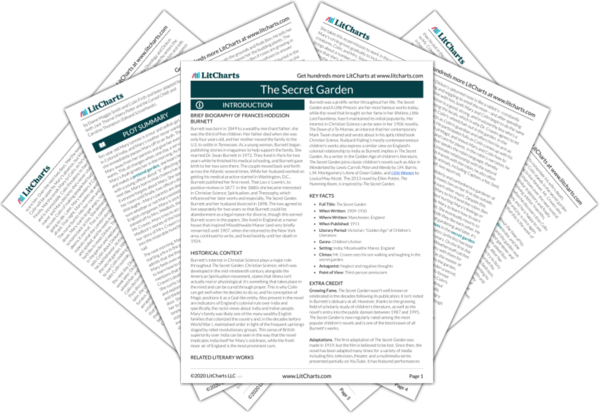
Brief Biography of Frances Hodgson Burnett Burnett was born in 1849 to a wealthy merchant father; she was the third of five children. Her father died when she was only four years old, and her mother moved the family to the U.S. to settle in Tennessee. As a young woman, Burnett began publishing stories in magazines to help support the family. She married Dr. Swan Burnett in 1872. They lived in Paris for two years while he finished his medical schooling, and Burnett gave birth to her two sons there. The couple moved back and forth across the Atlantic several times. While her husband worked on getting his medical practice started in Washington, D.C., Burnett published her first novel, That Lass o' Lowrie's, to positive reviews in 1877. In the 1880s she became interested in Christian Science, Spiritualism, and Theosophy, which influenced her later works and especially, The Secret Garden. Burnett and her husband divorced in 1898. The two agreed to live separately for two years so that Burnett could list abandonment as a legal reason for divorce, though this earned Burnett scorn in the papers. She lived in England at a manor house that inspired Misselthwaite Manor (and very briefly remarried) until 1907, when she returned to the New York area, continued to write, and lived lavishly until her death in 1924.
Get the entire The Secret Garden LitChart as a printable PDF. "My students can't get enough of your charts and their results have gone through the roof." -Graham S. Download
Historical Context of The Secret Garden Burnett's interest in Christian Science plays a major role throughout The Secret Garden. Christian Science, which was developed in the mid-nineteenth century alongside the American Spiritualism movement, states that illness isn't actually real or physiological; it's something that takes place in the mind and can be cured through prayer. This is why Colin can get well when he decides to do so, and his conception of Magic positions it as a God-like entity. Also present in the novel are indicators of England's colonial rule over India and specifically, the racist views about India and Indian people. Mary's family was likely one of the many wealthy English families that colonized the country and, in the decades before World War I, maintained order in light of the frequent uprisings staged by rebel revolutionary groups. This sense of British superiority over India can be seen in the way that the novel implicates India itself for Mary's sickliness, while the fresh moor air of England is the most prominent cure. Other Books Related to The Secret Garden Burnett was a prolific writer throughout her life; The Secret Garden and A Little Princess are her most famous works today, while the novel that brought on her fame in her lifetime, Little Lord Fauntleroy, hasn't maintained its initial popularity. Her interest in Christian Science can be seen in her 1906 novella, The Dawn of a To-Morrow, an interest that her contemporary Mark Twain shared and wrote about in his aptly titled book Christian Science. Rudyard Kipling's mostly contemporaneous children's works also express a similar view on England's colonial relationship to India as Burnett implies in The Secret Garden. As a writer in the Golden Age of children's literature, The Secret Garden joins classic children's novels such as Alice in Wonderland by Lewis Carroll, Peter and Wendy by J.M. Barrie, L.M. Montgomery's Anne of Green Gables, and Little Women by Louisa May Alcott. The 2013 novel by Ellen Potter, The Humming Room, is inspired by The Secret Garden. Key Facts about The Secret Garden Full Title: The Secret Garden When Written: 1909-1910 Where Written: Manchester, England When Published: 1911 Literary Period: Victorian; "Golden Age" of Children's Literature Genre: Children's fiction Setting: India; Misselwaithe Manor, England Climax: Mr. Craven sees his son walking and laughing in the secret garden. Antagonist: Neglect and negative thoughts Point of View: Third-person omniscient Extra Credit for The Secret Garden Growing Fame. The Secret Garden wasn't well known or celebrated in the decades following its publication; it isn't noted in Burnett's obituary at all. However, thanks to the growing field of scholarly study of children's literature, as well as the novel's entry into the public domain between 1987 and 1995, The Secret Garden is now regularly rated among the most popular children's novels and is one of the best known of all Burnett's works. Adaptations. The first adaptation of The Secret Garden was made in 1919, but the film is believed to be lost. Since then, the novel has been adapted many times for a variety of media including film, television, theater, and a multimedia series presented partially on YouTube. It has featured performances by Dame Maggie Smith and Colin Firth and been adapted by both Jack Thorne (Harry Potter and the Cursed Child) and Caroline Thompson (Edward Scissorhands). (责任编辑:) |