|
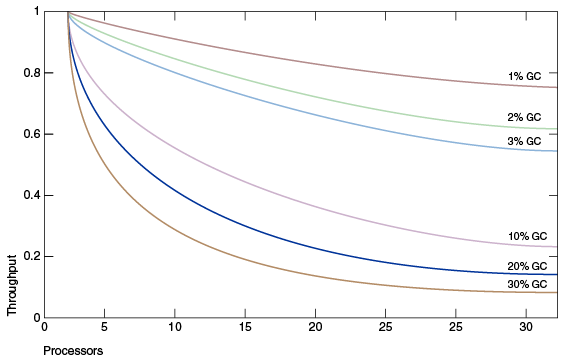
The purpose of a garbage collector is to free the application developer from manual dynamic memory management. The developer is freed of the requirement to match allocations with deallocations and closely take care of the lifetimes of allocated dynamic memory. This completely eliminates some classes of errors related to memory management at the cost of some additional runtime overhead. The Java HotSpot VM provides a selection of garbage collection algorithms to choose from. When does the choice of a garbage collector matter? For some applications, the answer is never. That is, the application can perform well in the presence of garbage collection with pauses of modest frequency and duration. However, this isn't the case for a large class of applications, particularly those with large amounts of data (multiple gigabytes), many threads, and high transaction rates. Amdahl's law (parallel speedup in a given problem is limited by the sequential portion of the problem) implies that most workloads can't be perfectly parallelized; some portion is always sequential and doesn't benefit from parallelism. In the Java platform, there are currently four supported garbage collection alternatives and all but one of them, the serial GC, parallelize the work to improve performance. It's very important to keep the overhead of doing garbage collection as low as possible. This can be seen in the following example. The graph in models an ideal system that's perfectly scalable with the exception of garbage collection. The red line is an application spending only 1% of the time in garbage collection on a uniprocessor system. This translates to more than a 20% loss in throughput on systems with 32 processors. The magenta line shows that for an application at 10% of the time in garbage collection (not considered an outrageous amount of time in garbage collection in uniprocessor applications), more than 75% of throughput is lost when scaling up to 32 processors.
Figure 1-1 Comparing Percentage of Time Spent in Garbage Collection
Description of "Figure 1-1 Comparing Percentage of Time Spent in Garbage Collection" This figure shows that negligible throughput issues when developing on small systems may become principal bottlenecks when scaling up to large systems. However, small improvements in reducing such a bottleneck can produce large gains in performance. For a sufficiently large system, it becomes worthwhile to select the right garbage collector and to tune it if necessary. The serial collector is usually adequate for most small applications, in particular those requiring heaps of up to approximately 100 megabytes on modern processors. The other collectors have additional overhead or complexity, which is the price for specialized behavior. If the application does not need the specialized behavior of an alternate collector, use the serial collector. One situation where the serial collector isn't expected to be the best choice is a large, heavily threaded application that runs on a machine with a large amount of memory and two or more processors. When applications are run on such server-class machines, the Garbage-First (G1) collector is selected by default; see . (责任编辑:) |