|
January 12, 2026 Daily Prices
Daily wholesale and retail prices for various energy products are shown below, including spot prices and select futures prices at national or regional levels. Prices are updated each weekday (excluding federal holidays), typically between 7:30 and 8:30 a.m. This page is meant to provide a snapshot of selected daily prices only. Prices are republished by EIA with permission as follows: Wholesale Spot Petroleum Prices from Refinitiv, Retail Petroleum Prices from AAA Fuel Gauge Report, Prompt-Month Energy Futures from CME Group, and Select Spot Prices from SNL Energy.
Daily Prices
Wholesale Spot Petroleum Prices, 1/09/26 Close
Prompt-Month Energy Futures, 1/09/26 Settlement
Notes for Prompt-Month Energy Futures
Select Spot Prices for Delivery Today
3:2:1 Crack Spread
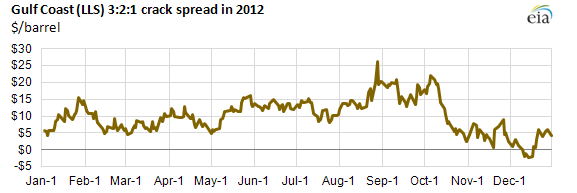
Source: U.S. Energy Information Administration, based on Thomson Reuters. A crack spread measures the difference between the purchase price of crude oil and the selling price of finished products, such as gasoline and distillate fuel, that a refinery produces from the crude oil. Crack spreads are an indicator of the short-term profit margin of oil refineries because they compare the cost of the crude oil inputs to the wholesale, or spot, prices of the outputs (although they do not include other variable costs or any fixed costs). The 3:2:1 crack spread approximates the product yield at a typical U.S. refinery: for every three barrels of crude oil the refinery processes, it makes two barrels of gasoline and one barrel of distillate fuel. To calculate the 3:2:1 crack spread for a Gulf Coast refinery that processes Louisiana Light Sweet (LLS) crude oil, add the spot price for two barrels of Gulf Coast conventional gasoline to the spot price for one barrel of Gulf Coast ultra-low sulfur diesel. Since prices for petroleum products are typically quoted in dollars per gallon, they must be multiplied by 42 gallons per barrel to convert to dollars per barrel. Then subtract the spot price for three barrels of LLS crude oil. Finally, divide the result by 3 to produce a crack spread in dollars per barrel. The figure illustrates the Gulf Coast (LLS) 3:2:1 crack spread during 2012. Because the 3:2:1 crack spread is a product of the interplay of three commodity prices, each subject to different but interconnected supply and demand balances, the range of values can vary widely. Product supply shortages resulting from serious disruptions such as hurricanes or other refinery or pipeline outages can cause large spikes of short duration. Updated: 2/4/2013
Regions for Select Spot Prices The following day-ahead natural gas and electricity prices, as reported by SNL Energy, are used to represent the following regions:
Region
Gas Point Used
Power Point Used
Updated: 2/4/2013
Spark Spread
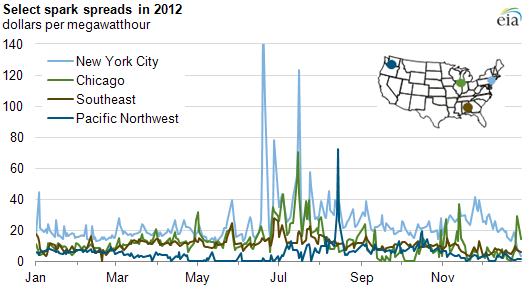
Source: U.S. Energy Information Administration, based on SNL Energy. The spark spread is a common metric for estimating the profitability of natural gas-fired electric generators. The spark spread is the difference between the price received by a generator for electricity produced and the cost of the natural gas needed to produce that electricity. It is typically calculated using daily spot prices for natural gas and power at various regional trading points. The chart above shows spark spreads during 2012, calculated for four locations around the United States. Spark spreads tend to be fairly volatile, more so than crack spreads in petroleum markets, largely because of the volatility of wholesale electric power prices, which vary widely with changes in demand for electricity and the available electric supply. Power prices formed in Regional Transmission Organizations (New York City and Chicago in the chart above) tend to be spikier than those formed in markets featuring bilateral trading between market participants (Pacific Northwest and Southeast). There is also variation in average spark spread levels across regions: New York City tends to have relatively high average spark spreads, while in the Pacific Northwest, a low average spark spread reflects low average power prices (because of an abundance of low-cost hydropower, particularly in the late spring and early summer). Note that spark spreads are not reported if they have negative values. Spark spread calculation. Spark spreads are calculated using the following equation:
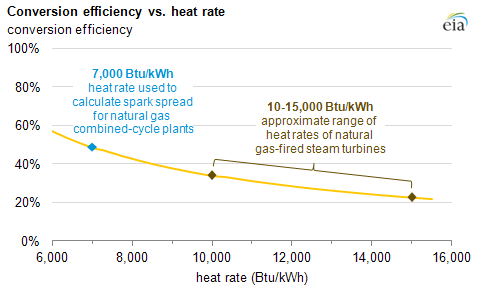
Source: U.S. Energy Information Administration The most efficient natural gas combined-cycle power plants have heat rates somewhat below 7,000 Btu/kWh; the spark spread for such units would be larger than the value shown here. Conversely, as a generating unit's efficiency decreases, the spark spread also decreases—thus, older, less-efficient plants have smaller spark spreads than those achieved with a heat rate of 7,000 Btu/kWh because they require more fuel per unit of output. Generators burning other fuels have similar metrics; for example, dark spreads (electricity price minus the cost of coal) are calculated for coal-fired generators, and quark spreads (electricity price minus the cost of enriched uranium fuel) for nuclear generators. A limitation of the spark spread calculation is that it does not take into consideration other costs associated with the generation of electricity, such as pipeline costs or fuel-related finance charges, and other variable costs (like operations and maintenance costs), taxes, or fixed expenses. In that sense, a spark spread is an indicator of market conditions, but it is not necessarily an exact measure of profitability for any one specific generator. (责任编辑:) |